Muscle Delta Myofascial Robot Therapy System
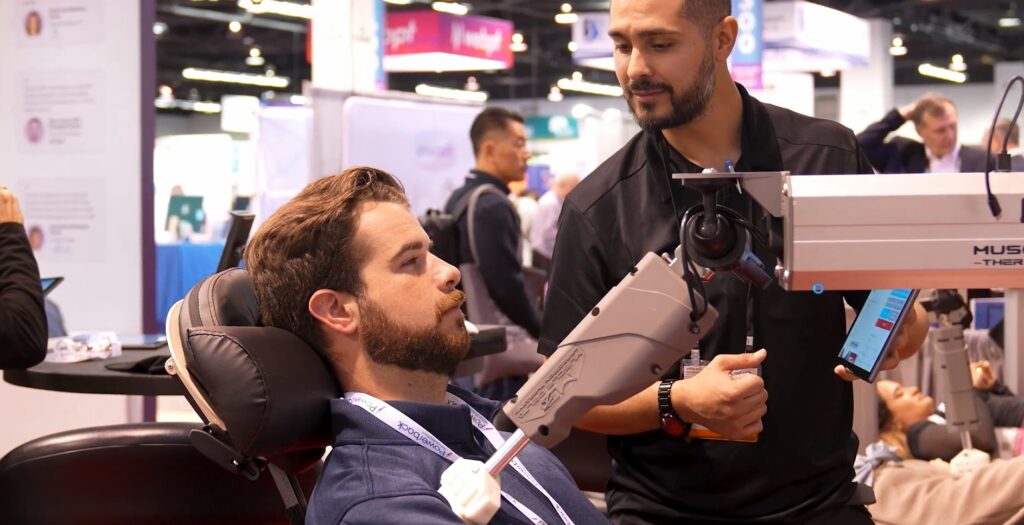
Technology Overview
The Muscle Delta Myofascial Robot is a therapist-operated mechanical device that applies controlled pressure to muscle and myofascial tissues to restore muscle length and function. It assists clinicians in addressing all types of soft-tissue restrictions, and shortening while reducing physical strain on the provider.
Key Features
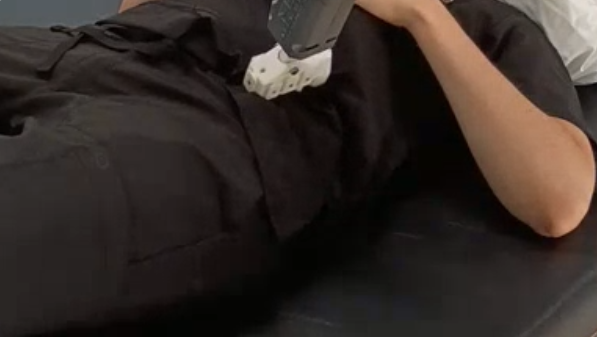
- Adjustable pressure delivery: Tailored for specific muscular or myofascial structures.
- Interchangeable treatment heads: Designed to contour to various anatomical regions and fascial planes.
- Clinician-controlled precision: Ensures real-time assessment of patient response during treatment.
- Integrated targeting database: Helps clinicians identify functionally relevant muscular and myofascial units.
- Reproducible protocols: Supports standardized treatment strategies across sessions.

Safety Profile
Muscle Delta Myofascial Therapy Robot is a collaborative robotic system developed to operate within established safety and performance frameworks for medical and robotic technologies. Its design aligns with collaborative robot principles, where system behavior, force limitations, motion constraints, and interaction boundaries are evaluated as part of the full robot system, not the arm alone. In collaborative robotics, standards such as ISO/TS 15066:2016 and RIA TR R15.606-2016 help define the safety requirements for human-robot interaction, and the Muscle Delta Assistant is built with those expectations in mind.
The system also reflects widely recognized medical electrical and software standards used for clinical technology. These include IEC 60601-1 for basic safety and essential performance, IEC 60601-1-2 for electromagnetic compatibility, IEC 60601-1-6 and IEC 62366-1 for usability engineering, IEC 62304 for medical device software life cycle processes, and ISO 14971 for medical device risk management. Additional guidance relevant to medical robots, autonomy, and immunity includes IEC TR 60601-4-1, IEC TR 60601-4-2, and IEC 80601-2-78, which addresses particular requirements for medical robots used in rehabilitation and assessment.
Muscle Delta devices are non-invasive, 510(k) exempt, and manufactured by AHI Automation in Henderson, Nevada, a UL-listed assembler. Each unit visibly displays the UL listing sticker to confirm electrical certification, and the platform has been used in clinical and sports settings, including hospital-based applications and professional athletic environments. That combination of standards-based design, verified manufacturing, and real-world adoption supports a clinical positioning focused on safety, consistency, and operational reliability.
Muscle Delta Case Study:
Muscle Delta Case Study:
74-Year-Old Male Recovering from Brain
Cancer Surgery
Introduction
History
Tests and Measurements
Upon evaluation, the patient reported minimal pain, with a Numeric Rating Scale (NRS) score of 1 out of 10 for pain at rest, during normal activity, and during intended activity. However, his mobility was severely restricted, particularly in the right hip, which contributed to his risk of tripping and falling.
Using Muscle Delta’s state-of-the-art Range of Motion (ROM) tool, the following measurements were recorded:
● Right hip flexion: 51 degrees (39% of normal while standing; less than 20% during walking)
● Right knee flexion: 73 degrees (approximately 50% less than normal)
These results confirmed significant mobility limitations, necessitating targeted treatment.
Treatment
Based on the ROM tests and musculoskeletal analysis, the therapy focused on the following muscles:
● Psoas/Iliacus
● Rectus Femoris
● Popliteus
Considering the patient’s age and condition, a conservative treatment plan was implemented, using low-pressure settings. The intensity was gradually increased based on the patient’s feedback to ensure comfort and safety
Throughout the three-month treatment period, the patient provided positive feedback. He was delighted with the results, stating, “I walk better!” He also noted that the therapy felt safe, unlike previous treatments like chiropractic and manual therapy, which had caused anxiety and fear of
injury. With Muscle Delta’s consistent and precise approach, he looked forward to each session.
Results
After three months of Muscle Delta’s therapy, the patient achieved significant improvements in mobility:
● At 1.5 months:
○ Right hip flexion: 76 degrees (20% increase from initial)
○ Right knee flexion: 96 degrees (15% increase from initial)
● At 3 months:
○ Right hip flexion: 90 degrees (32% increase from initial)
-.Concurrent knee flexion: 112 degrees (25% increase from initial)
The patient reported walking longer distances each week, gaining confidence in his mobility, and finding it easier to get in and out of cars. He also experienced an enhanced sense of well-being, which is particularly significant for geriatric patients who often face progressive decline. These improvements underscore the therapy’s impact on both physical function and mental health.
Discussion
Muscle Delta’s Precision Musculoskeletal Therapy is a safe, effective, and comfortable treatment option for geriatric patients. Its non-invasive, medication-free, and efficient approach restores patients to a healthy, pain-free state quickly. Compared to other deep-penetration therapies, such as laser, shock, or electrical treatments, Muscle Delta’s precise pressure application avoids the risks associated with high-energy settings, which can harm other bodily systems. This therapy promotes physiological changes that enhance healing and restoration.
Advanced training in Muscle Delta’s technology explores the skeletal muscle’s hierarchical structure and the benefits of precise therapy on related systems. The therapy also induces positive cellular changes, further supporting muscle health and overall well-being.